KANVAS BY METAL FABRIK
Custom Metal Entrance & Garage Doors in Dubai: A Design, Security & Specification Guide
A door makes two impressions: first as part of the architecture, then every day through how well it opens, seals and protects the property. In Dubai, it must also perform through intense heat, humidity, dust and, in coastal locations, salt-laden air.
That is why a premium door needs more than an attractive surface. The frame, base material, finish, hardware and access system must work as one engineered assembly.
This guide explains what to consider when specifying custom metal entrance doors and garage doors in Dubai, how the two applications differ, and how KANVAS by Metal Fabrik brings design, fabrication, finishing and security together.
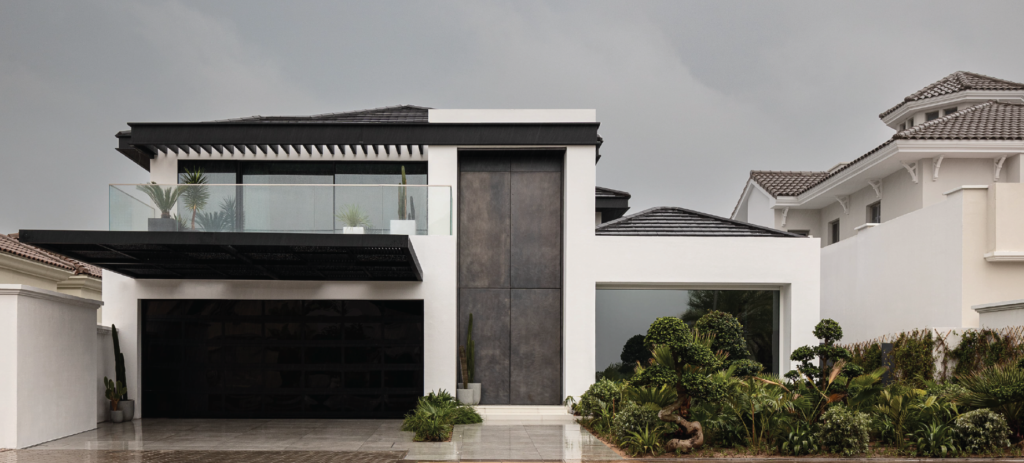
Why Choose a Custom Metal Door System?
Off-the-shelf doors suit standard openings and straightforward requirements. Custom fabrication becomes valuable when the architecture, scale, finish or performance brief demands more.
- A specification suited to the UAE climate. For example, designers can select the base metal, protective coating, seals and hardware to suit the property’s exposure to heat, humidity, dust and coastal conditions.
- Security designed into the assembly. Moreover, the design team can coordinate reinforced frames, multi-point locks, digital access and other hardware before fabrication instead of adding them later.
- Architectural continuity. The door can match the building’s proportions and material palette, whether the façade uses stone, glass, timber or architectural metal cladding. See how material and detailing work together in our recent wall-cladding projects.
- Freedom in scale and detailing. In addition, engineers can develop oversized pivot doors, concealed frames, integrated handles, patterned panels and wide garage openings around the actual site conditions.
The result is not simply a metal panel. Instead, it is a complete door system that responds to the opening, the architecture and the way people will use the property.
Entrance Doors and Garage Doors Require Different Engineering
Although both can share the same design language, an entrance door and a garage door perform different jobs.
Entrance Doors
An entrance door must balance daily use, security and visual impact. Key considerations include:
- Proportion and opening style: hinged, double-leaf and oversized pivot doors place different loads on the frame and hardware.
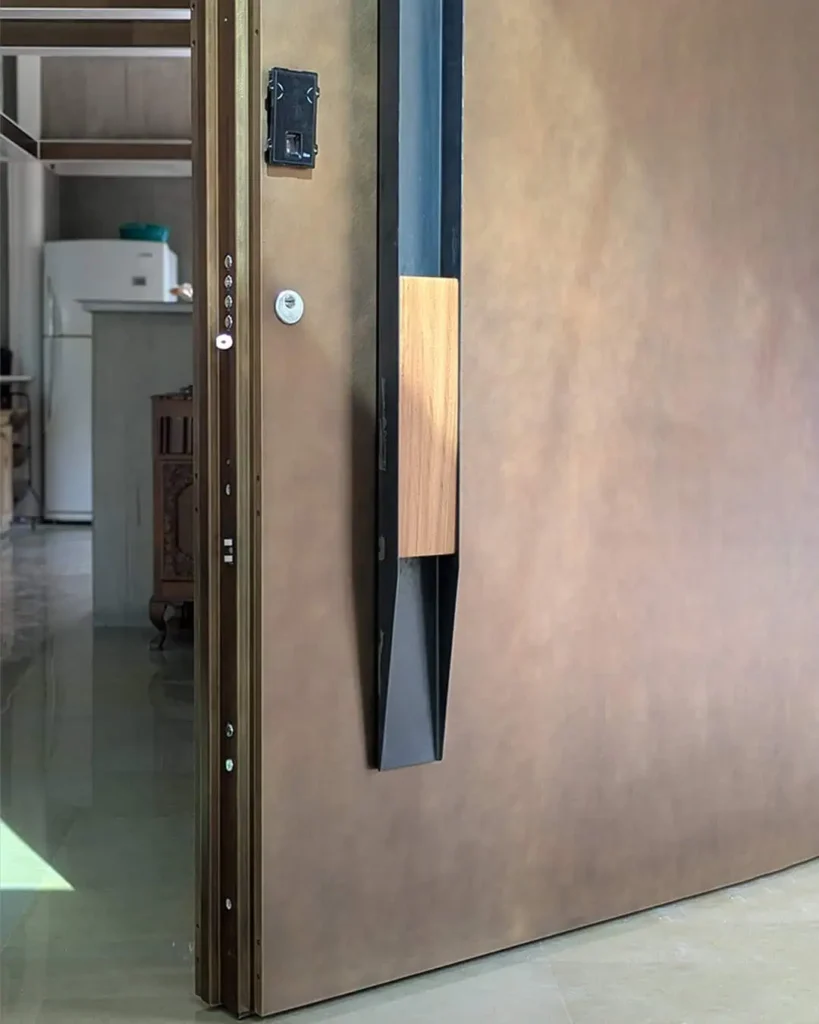
- Finish and texture: patina, bronze, stainless steel, HR Black and other specialist surfaces can make the entrance part of the architectural composition.
- Locks and access control: coordinate multi-point locking, digital access, biometric entry and smart-home integration early in the design.
- Thermal and weather detailing: metal conducts heat, so insulation, thermal breaks, gaskets and threshold design require careful attention.
- Handle ergonomics: the pull length, projection and fixing points must suit the door’s weight and intended users.
Garage Doors
A garage door is a larger moving system. Its appearance matters, but safe and reliable operation comes first.
- Opening mechanism: sectional, sliding and tilt systems require different tracks, clearances and structural support.
- Span and weight: a double or triple garage opening needs calculated panel weight, reinforcement and load capacity.
- Motor and controls: the motor, safety sensors, manual release and access controls must be compatible with the completed door.
- Wind and weather sealing: panel stiffness, bottom seals and side gaskets help reduce dust and driven rain entering the garage.
- Maintenance access: motors, tracks, rollers and sensors should remain accessible for inspection and servicing.
If a proposal treats both applications as the same product in different sizes, ask for more detail.
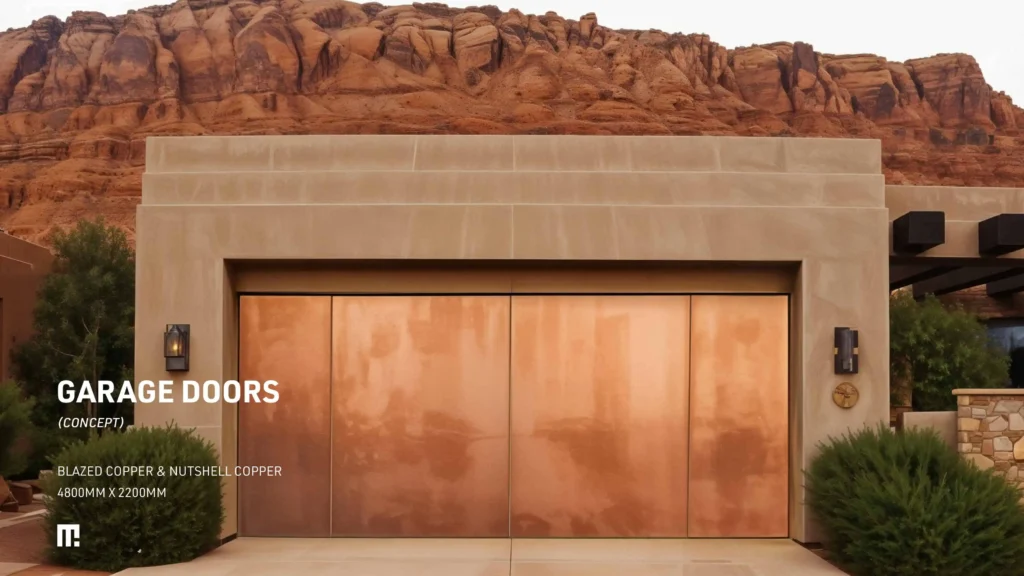
What Makes KANVAS by Metal Fabrik Different?
KANVAS is Metal Fabrik’s collection of custom entrance and garage doors. It combines precision metal fabrication with handcrafted finishes and integrated security systems, so the team can develop the door as an architectural feature instead of choosing a standard fitting.
The KANVAS entrance-door range offers custom options for:
- The opening size and door configuration
- The design language and panel composition
- Handles and architectural hardware
- Locking and digital access systems
- Bespoke metal finishes and protective coatings
Finish options include Acid Washed Patina, HR Black, Corten Rust, Antique Brass, burnished metals and custom-developed surfaces. Because handcrafted finishes contain natural tonal variation, review samples under the project’s actual lighting before approval. Our guide to patina in architecture explains how craftspeople create, protect and maintain these finishes.
Metal Fabrik also collaborates with Silvelox Italy, bringing specialist security-door and garage-door systems together with Metal Fabrik’s engineering, fabrication and finishing capabilities. Depending on the approved specification, this can include multi-point locking and digital-access technology within a clean, coordinated design.
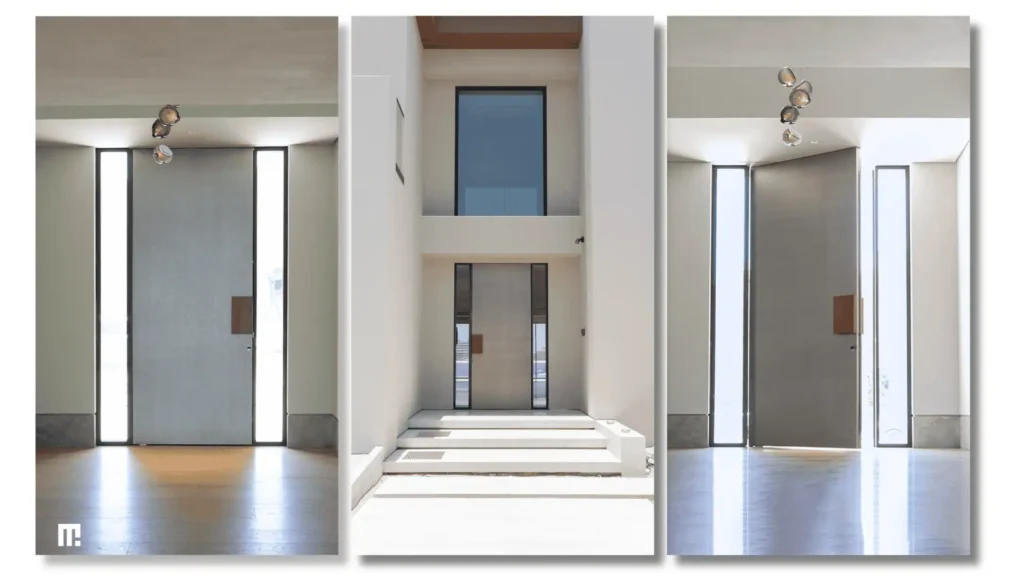
Design Directions for a Custom Metal Door
The right finish should belong to the building, not compete with it. Common design directions include:
- Patina and antique-brass finishes for warmth, depth and natural tonal movement
- HR Black and dark metallic finishes for restrained, contemporary façades
- Corten Rust for an expressive, weathered character where the application and detailing are suitable
- Perforated or cut-pattern panels for ventilation, filtered visibility or a screen-like effect
- Mixed-material compositions combining metal with timber, glass or stone
- Integrated handles and concealed details for a quieter, more architectural appearance
Always approve a physical finish sample. Colour, texture and reflectivity can look very different on screen, in a showroom and in direct sunlight.
The Technical Questions to Ask Before Ordering
A rendering can show proportion and finish, but it cannot prove how the door will perform. Before approving a proposal, ask the fabricator to confirm the following in writing:
- Base material and thickness — which metal the fabricator will use, why it suits the location, and how its thickness relates to the door size and reinforcement strategy.
- Frame and load design — how engineers rate the frame, pivots, hinges, tracks or rollers for the completed door weight.
- Lock and access compatibility — how the design team integrates the chosen locking system into the shop drawings and coordinates it with power, data and smart-home requirements.
- Insulation and sealing — how the door limits heat transfer and how the perimeter, threshold and panel joints resist dust and water.
- Corrosion protection — the preparation, coating, plating or sealing system specified for the site’s exposure conditions.
- Garage-door safety — motor sizing, obstruction detection, safety sensors, manual release and maintenance access.
- Compliance requirements — whether the door forms part of an escape route or requires a tested fire rating. For commercial and regulated projects, project teams should check the specification against the UAE Fire and Life Safety Code of Practice and the approvals required for the property.
- Warranty and maintenance — what is covered for the finish, structure, lock, motor and installation, and for how long.
Thicker metal is not automatically better. Ultimately, what matters is whether the design accounts for the assembly’s size, weight, movement and environment.
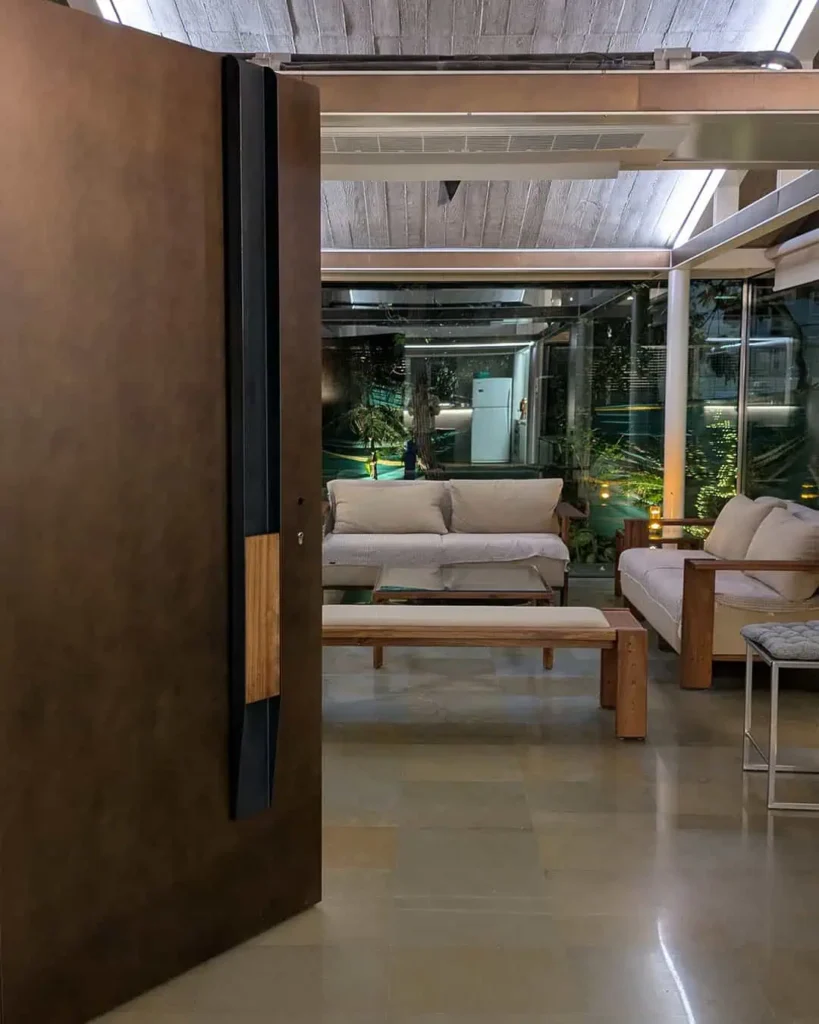
How the Custom Fabrication Process Works
A well-managed project moves through clear approvals before production begins. Metal Fabrik’s wider design, build and installation process provides the same discipline for bespoke door projects.
- Project brief and site assessment — confirm opening dimensions, wall build-up, floor levels, access requirements and architectural intent.
- Scope, design and material selection — agree the door type, panel layout, finish direction, hardware and controls.
- Shop drawings and engineering — coordinate the structure, frame, clearances, fixing points, lock, motor and electrical provisions.
- Finish sample and approval — review the real material under suitable lighting, especially for patina and burnished surfaces.
- Fabrication and pre-delivery checks — fabricate, finish, assemble where practical and verify the fit and operation before dispatch.
- Installation and handover — align the door, commission the lock or motor, test safety functions and provide care guidance.
Clear approval points protect both the design and the programme. They also make it easier to identify changes before they become costly site problems.
What Influences the Cost of a Custom Metal Door?
Fabricators price custom metal doors to specification. The main cost drivers are:
- Overall size and configuration — oversized leaves, wide spans and multi-panel systems require more material and engineering.
- Base material and reinforcement — the selected metal, internal structure and site exposure affect the build-up.
- Finish complexity — powder coating is generally simpler than a hand-applied patina, burnished finish or mixed-material composition.
- Hardware and automation — pivot systems, architectural handles, multi-point locks, digital access, motors and safety sensors add cost.
- Testing and compliance — rated assemblies or project-specific approvals may require additional documentation and coordination.
- Installation conditions — access, lifting requirements, tolerances and integration with completed finishes can affect site work.
When comparing quotations, check that each one includes the same material, thickness, reinforcement, finish system, hardware, motor, installation scope and warranty. Two doors that look similar in a rendering may be very different specifications.
How to Choose the Right Door Fabricator
Ask for evidence that matches the work you are commissioning:
- Can the fabricator show completed entrance or garage doors of a similar scale?
- Are design, engineering, fabrication, finishing and installation coordinated by one team?
- Will you receive shop drawings and a physical finish sample before production?
- Are the lock, access system and garage-door controls specified by brand and model?
- Can the team explain how the proposed materials suit the site’s exposure conditions?
- Does the proposal separate the warranty clearly between the finish, structure, hardware and motor?
- What maintenance will the door require after handover?
Specific answers are more valuable than broad promises. They reveal whether the fabricator developed the proposal as a complete system or priced it as a decorative shell.
Frequently Asked Questions
What is the difference between a standard aluminium door and a custom metal door?
Suppliers normally offer a standard aluminium door in fixed sizes, profiles and finishes. By contrast, fabricators develop a custom metal door around the actual opening, architectural design, hardware and performance brief. Depending on the project, it may use steel, stainless steel, aluminium or a combination of materials.
Are metal entrance doors more secure than timber doors?
A properly engineered metal assembly can provide strong resistance to forced entry, but the material alone does not determine security. The frame, reinforcement, hinges or pivot system, lock, fixings and installation all need to work together.
Can you motorise a custom garage door?
Yes. Installers can motorise sectional, sliding and tilt garage doors when they coordinate the motor, track, panel weight, safety sensors and manual release from the start. Choose the final mechanism according to the door size and frequency of use.
Which finishes are available for KANVAS doors?
KANVAS finish options include Acid Washed Patina, HR Black, Corten Rust, Antique Brass, burnished metals and custom-developed surfaces. Suitability depends on the base material, location, exposure and maintenance expectations, so approve a physical sample and finish specification before fabrication.
How long does a custom entrance or garage door take?
The programme depends on design complexity, engineering, finish, hardware availability, approvals and site readiness. Request a project-specific schedule after the team confirms the design and specification rather than relying on a generic lead time.
Do custom metal doors require maintenance?
Yes, although the routine depends on the finish and mechanism. Clean coated or sealed surfaces with approved non-abrasive products, inspect seals and drainage points, and service locks, pivots, tracks, motors and safety sensors at the recommended intervals.
Start with the Material, the Opening and the Way You Want the Door to Feel
The best entrance and garage doors feel effortless because the team has already resolved the difficult decisions: proportion, structure, movement, security, sealing and finish.
Bring your opening dimensions, architectural drawings, reference images and preferred access system to MF Gallery in Dubai. You can compare real finishes, discuss buildability and refine the specification before fabrication. Explore KANVAS and visit MF Gallery, or contact the Metal Fabrik team to arrange a project consultation.